
Raptors
Accipiter/Astur
Buteos
Eagles
Falcons
Vultures
Odds & Ends
Accipiter/Astur
The Sharp-shinned Hawk, the Cooper’s Hawk and the American Goshawk all exhibit similar characteristics even though the Sharp-shinned Hawk is not closely related to the other two species. The Sharp-shinned Hawk evolved similar characteristics due to a phenomenon called convergent evolution. Therefore, we have grouped these three species together. All three species possess relatively short wings and long tails compared to other raptors. These proportions allow them to make tight turns in flight. They are known for their stealth. From a strategic perch, they will use the element of surprise to capture their prey. The Sharp-shinned Hawk and the Cooper’s Hawk can be a challenge to separate, especially when perched, as many of their field marks are similar. Still, there are key differences in their field marks as well as in their flight behaviour to separate and identify them. For a closer look at these three species, go to the “About” pull down and look under “Resources” to find the “Accipter/Astur ID Table” and the “Accipiter/Astur Flight Chart”.
Sharp-Shinned Hawk
Our only Accipiter is relatively abundant with thousands seen during migration. In size, they present the greatest range of any raptor species in Ontario. It can range from 9.5 inches to 13.5 inches in length and weighs between 3 and 8 ounces. It has a light wing load so easily buffeted by winds. In flight, it soars and glides with intermittent flaps more often than a buteo. It has fast wingbeats, that look lose and butterfly-like, and its shape often suggests a small head sitting inside a pocket formed along the leading edge of the wing. Its tail is not as rounded as the Cooper’s, and when tucked in, it is more likely to look squared off than a Cooper’s Hawk.
General Appearance

By: Keith Dieroff
Overhead View

Cooper's Hawk
The Cooper’s Hawk is part of the astur genus. This species is very similar in appearance to the Sharp-shinned Hawk even though they are not closely related. The Cooper’s Hawk is roughly crow-sized, ranging from 15 to 18 inches in length and they weigh between 10 to 22 ounces. They have a relatively heavier wing load compared to the Sharp-shinned Hawk which is reflected in their flight. In flight, it also soars and glides with intermittent flaps more often than a buteo. Their wing beats however, are relatively slower and look more controlled than a Sharp-shinned Hawk. In a full soar, the Cooper’s Hawk can look like a flying cross; the leading edge of the wings forms the shorter horizontal beam, and the head to tail forms the longer vertical post of the cross.
General Appearance

By: Keith Dieroff
Overhead View

American Goshawk
A large and powerful Astur species, the American Goshawk can look reminiscent of a Red-tailed Hawk because it has relatively longer wings, than the other two species in this grouping. However, it does have a relatively long tail, separating it from buteo species which have shorter tails. Its size ranges from 19 to 25 inches in length and it weighs 600 and 1200 grams. In flight, this species has a steady, powerful wing beat.
General Appearance

By: Tom Thomas
Overhead View

Buteos
Buteos are what we typically imagine when we think “hawk”, and we visualize them soaring on broad wings and a shortish tail. Separating and identifying buteo species can be a bit challenging but each species has a unique combination of field marks, proportions, and flight behaviour making identification possible, even at long distances. For a closer look at these four buteo species, go to the “About” pull down and look under “Resources” to find the “Buteo ID Table” and the “Buteo Flight Chart”.
Red-tailed Hawk
General Appearance

By: Rjmscorley
Overhead View

Red-Shouldered hawk
This species is known for their elegant appearance. When perched, they are approximately the same length as a Red-tailed Hawk but appear longer as they are slimmer in the body. In flight, their wingspan is a touch smaller than Red-tailed Hawks but appears longer against the slimmer body and longer tail. Adults have a contrasting black and white pattern in the wing and tail, red on the “shoulder”, and their underparts have a rich orange-colour. Juveniles can be quite muted in colour, causing patterns to be less obvious. Both age classes have translucent crescents along the outer part of their underwings. High-flying individuals can still be identified by their shape, proportions and their wingbeats, which appear fluttery due to their relatively light wing load.
General Appearance

By: Peter Benoit
Overhead View

Broad-Winged Hawk
This is a crowd-pleasing species at any eastern hawkwatch, as they typically migrate in large numbers known as kettles. Their unique shape includes tapered wings, and the shortest tail relative to other buteos. Adult field marks include pale underparts with reddish-brown on the chest, the wings have a dark trailing edge with dark primary wingtips, and broad black and white bands on the tail. Juveniles have a pale chest, and typically have dark streaking along the face, throat, sides, and belly, and the tail has narrow bands. The juveniles have dark wingtips but do not exhibit a dark trailing edge to the wings. From below, this species is often seen in soaring kettles or gliding one after another in a long line in the sky.
General Appearance
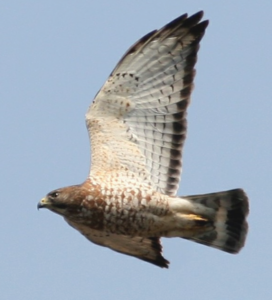
By: Tom Thomas
Overhead View

Rough-legged Hawk
“Roughies” are a circumpolar species that breed in the arctic, and winter in southern parts of Canada and the upper states. They can be seen in southern Ontario over the winter near open fields with tallish trees nearby. They are the largest buteo of the four. When perched at a distance, this species shape is reminiscent of a Red-tailed Hawk but with a smaller beak and feet. If you can see their face marking in your binoculars, you will notice an overall pale appearance with a short dark eye line. When they alight, the contrasting white and black areas on their bodies, wings, and tail are stunning. However, note that the pattern of black and white is variable. In flight, their wings are the longest of all the four buteo species as their primaries have longer feathers. They are adept at powered flight, and their wingbeats are typically steady and deep.
General Appearance

By: Skeeze
Overhead View

Eagles
The Bald Eagle and the Golden Eagle are the largest and most powerful birds of prey seen in Ontario with wingspans close to seven feet wide. These birds take four to five years to reach maturity with some subtle and not so subtle distinctions in plumages along the way. Bald Eagles are a North American species that live near water bodies where they forage for their favourite food, fish. The Golden Eagle lives in North America, Europe, Asia, and North Africa. This species can kill prey larger than itself but feasts mainly on small to medium-sized mammals. For a closer look at eagles, go to the “About” pull down and look under “Resources” to find the “Eagle ID Table” and the “Vulture/Eagle Flight Chart”.
Bald Eagle
The adult Bald Eagle has a unique and contrasting plumage from other raptors. It has a white head and tail with a dark body and wings making it easy to identify. Their plumage colouration in its first year of life (juvenile) and sub-adult years are quite different. As a juvenile, the head and beak are dark (not yellow), the wings are dark with a variable amount of white blotchiness, the body is dark, and the tail is mostly dark. The trailing edge of the wing is even and the feathers look pointy. As a sub-adult, the head gradually acquires white feathers, and the beak gets more yellow. The body, wings, and tail go through various iterations of dark plumage offset by white speckling and/or blotchiness that changes in each annual moult cycle. The trailing edge of the wing is uneven. In a full soar, a Bald Eagle’s shape in any age class can be recognized by its exceptionally long wings stretched out like a plank placed perpendicular to its body, head, and tail.
General Appearance

By: Tof Mayanoff
Overhead View

Golden Eagle
The Golden Eagle has different proportions than the Bald Eagle. Its size, weight and wingspan are similar, but they have a relatively smaller head and beak. Its appearance in all age classes is mainly dark, with a golden nape that can light up when caught in sunlight. As a juvenile, the plumage is uniformly dark, with white at the base of the tail. Also, it typically shows white at the base of its flight feathers. As a sub-adult and adult, it is essentially an all-dark bird in the body and wings with key ageing differences in the tail. Each year, the tail will replace some black and white juvenile tail feathers with ones that have more grey mottling. By the time it reaches adulthood, the tail is dark with grey mottling, with little to no white left. Identifying a Golden Eagle in flight is a special experience as this species is an uncommon sight in the east. In a soar the wings are in a slight dihedral, and when flapping, the wingbeats are strong and will end abruptly on an upstroke.
General Appearance

By: Kevsphotos
Overhead View

Falcons
Ontario is frequented by three falcon species. With long tapered wings, they possess superior speed and strength. They capture prey on the wing but will also take prey off the ground, the American Kestrel being an excellent mouser. Interestingly, falcons are more closely related to parrots than other raptors, and they have unique traits such as a tomial tooth (a notch in the upper bill) to dispatch prey in flight, and they have a distinctive orbital skin around their eyes, and baffles in their nostrils. For more details, go to the “About” pull down and look under “Resources” to find the “Falcons ID Table” and the “Falcons Flight Chart”.
American Kestrel
This species is the most colourful of all raptors frequenting Ontario. Both age classes and sexes have two vertical marks on the face, and a row of dots along the trailing edge of the wing, often referred to as a string of pearls. The male’s wings are a beautiful blue-gray colour on the topside, and the tail is bright rufous with a contrasting dark sub-terminal band. From below the body is palish with spots on the chest. The female’s wings and tail are rufous with black barring, and from below, the body is palish with red to brown streaking. The male and female juveniles look like their adult counterparts. This species is the smallest falcon of the three, with a wingspan range of 1’8” to 2’ wide and weighs between 3 to 6 ounces. With their light wing load, kestrels have fluttering wingbeats and they are easily buffeted by the wind.
General Appearance

By: Reitz27
Overhead View

Merlin
Although close in overall size to the American Kestrel, the Merlin is heavier, chestier, and has a relatively larger head. The sexes look alike and have one dark marking on the face ranging from a blurry thin line to a wider smudgy patch, light and dark checkered wings, and a dark tail with thin pale bands. From above the male has a metallic blue colour and the female is a slate brown. From below, the juvenile has heavier streaking on the body. In flight they are direct and have fast piston-like wing beats.
General Appearance

By: Adriankirby
Overhead View

Peregrine Falcon
The largest of Ontario’s common falcons, the Peregrine Falcon has a wingspan ranging from 3’3” to 3’7”. This species has a bold and distinct mark along the side of the face, checkered wings and thinly barred tail. The body is a blue gray colour from above and heavily barred from below with a white throat and upper chest. Its flight is direct with exceptional speed, and the wingbeats are whip-like and relatively less deep than a Merlin.
General Appearance

By: Ruthmcd
Overhead View

Harrier
The Northern Harrier is well adapted to hunting over grasslands, meadows, and marshes. They have a facial disk akin to an owl to channel sound to their ears, excellent eyesight and their relatively long legs allow them to pluck their prey out of long grasses. They are often seen flying low over open areas, but on migration they can be seen high in the sky. The Northern Harrier is a medium-sized raptor with long slender wings, body and tail. The neck is thick and the head projection often looks blunt. For a closer look at the harrier, go to the “About” pull down and look under “Resources” to find the “Osprey and Harrier ID Table” and the ““Osprey/Harrier Flight” Chart.
Northern Harrier
Adult male and female harriers have different plumage. The male is silvery gray above with a gray head. From below, the body and wings are mainly white with black on the primary feather tips and along the trailing edge of the wings. The female is mostly brown with dark streaking along the chest and flanks and barring on the wings and tail. The juvenile looks like the female but on the top side it often shows rufous in the wing coverts, and from underneath the wing coverts are a cinnamon-orange. The belly has a pinkish-toned wash with little to no streaking. The head colour of a juvenile is typically darker than that of an adult female. In all age classes and in both sexes, individuals show a conspicuous white patch on the “rump”. In a soar, the wings are held in a dihedral, and with wind, they often tip side to side due to their light wing load.
General Appearance

By: Skeeze
Overhead View

Osprey
The Osprey is an obligate fish-eating raptor, so typically seen not-too-distant from an open body of water. When they spot prey, they will go into a stoop and plunge down towards the water and at the very last second, they will pull their wings up and thrust their feet out in front to capture their prey with their talons. Their talons are long and rounded, serving as eight fishhooks. Their toes have spicules to also help secure slippery fish, and they can hyperflex them to capture or release their prey. This species will nest in tall dead trees or tall man-made platform structures such as hydro poles with a platform built on top. For a closer look at the Osprey, go to the “About” pull down and look under “Resources” to find the “Osprey and Northern Harrier ID Table” and the “Osprey/Northern Harrier Flight Chart”.
Osprey
This medium-sized raptor has a distinctive combination of dark brown and white plumage. An adult has a white body, sometimes with a bit of dark streaking on the breast, and white underwing coverts except for a noticeable dark patch at the wrist (the bend of the wing). The head is also white with a broad black mask over the eyes and face, and it has a black beak. The flight feathers of the wings are mostly dark, and the tail is finely barred. The juvenile is like the adult but will have a buffy tone on the underwing coverts and exhibit white edging on the feathers. The Osprey has very long wings and a relatively short tail. In a soar, they typically hold their wings with their wrists reaching forward and their primary feathers swept back, creating the impression of an M-shaped silhouette from below.
General Appearance

By: Skeeze
Overhead View

Vultures
There are two vulture species that migrate into Ontario. Turkey Vultures are a highly abundant species seen at the hawk count, with a total of approximately 6500 individuals each spring. The Black Vulture, on the other hand, is still a single digit total each spring. However, they are expected to expand their range north with climate change. These vultures, with there overall dark appearance, can be seen from a great distance away. For more details on vultures, go to the “About” pull down and look under “Resources” to find the “Vulture ID Table” and the “Vulture and Eagle Flight Chart”.
Turkey Vulture
This vulture is regularly seen soaring in a dihedral with wings tipping from side to side due to its light wing load. Its wingspan ranges from 5’7” to 5’10” and it weighs approximately 4 lbs 7 oz. This species has a dark brown, almost black body and underwing coverts, with lighter coloured flight feathers than can shine a silvery gray. This gives it a two-toned appearance from below. They have a naked red head and an ivory bill as an adult. The juvenile has a dark head and dark gray bill. In a full soar, their wings are broad and long, with very little head projection. Occasionally it will offer one deep flap to correct its course, and much less often it will flap repeatedly.
General Appearance

By: Greg Seymour
Overhead View

Black Vulture
Black Vultures are an all black species except for a contrasting grayish white patch along the wing tips. They have a naked grey head and bill. The head and tail project equidistant from the body with minimal projection. It is smaller than the Turkey Vulture with a wingspan range of 4’6” to 4’11” and weighs 3lbs 8 oz to 4 lbs 13 oz. In a soar, the wings are flat or in a slight dihedral. It is more stable in winds and flaps more often than a Turkey Vulture with quick, choppy wingbeats.
General Appearance

By: Dan Cross
Overhead View

Rarities
While these birds come from the other groups mentioned here, they aren’t expected, or regularly observed at the Niagara Peninsula Hawkwatch. Many observers each year are hoping to come across one of these birds.
Swainson's Hawk
The Swainson’s hawk is a long-winged buteo that flies with wings held in a dihedral. Adults have light underwing coverts and dark flight feathers, whereas juveniles are less strongly marked.
General Appearance

By: Skeeze
Overhead View

Ferruginous Hawk
This is our largest buteo with long, fairly pointed wings. Both light and dark morphs occur, but the tail and particularly flight feathers are white in both.
General Appearance

By: Reitz27
Overhead View
drawing
Prairie Falcon
Prairie falcons are similarly sized to peregrine falcons, but more lightly coloured. Dark underwing coverts and axillaries are diagnostic marks.
General Appearance
By:
Overhead View
drawing
Gyrfalcon
This is a huge falcon that may be white, grey, or brown. These birds are unlikely to be mistaken for another.
General Appearance

By: Skeeze
Overhead View
drawing
Mississippi Kite
A medium-sized kite, these birds are grey overall with a lighter head. This, combined with their long, tapered wings and graceful flight help distinguish them in the field.
General Appearance
By:
Overhead View
drawing
Swallow-tailed Kite
This dramatic bird is unlikely to be confused by anything else due to its long, forked tail, white underwing coverts and black flight feathers.
General Appearance

Overhead View
drawing